

Spondylolisthesis Treatment in Redondo Beach CA
Understanding Spondylolisthesis in Redondo Beach CA
If you've been told you have spondylolisthesis, you may be wondering whether surgery is inevitable or if there are conservative treatment options available. The good news is that many individuals with spondylolisthesis in Redondo Beach CA can successfully manage their symptoms and maintain an active lifestyle with the right diagnosis, treatment plan, and guidance.
At Arc of Life Chiropractic, we believe that understanding the cause of your pain is the first step toward finding lasting relief. Our goal is not simply to reduce symptoms temporarily but to identify the underlying mechanical issues contributing to your discomfort and develop a personalized treatment plan that helps you move and function with greater confidence.
What Is Spondylolisthesis?
Spondylolisthesis occurs when one vertebra slips forward in relation to the vertebra beneath it. This most commonly occurs in the lower back (lumbar spine), particularly at the L4-L5 or L5-S1 levels.
This forward movement can place stress on the joints, ligaments, muscles, and spinal discs. Depending on the amount of slippage and whether nearby nerves become irritated, symptoms can range from mild stiffness to significant back pain, leg pain, numbness, tingling, or weakness.
Not everyone with spondylolisthesis experiences pain. Many people discover the condition only after spinal X-rays are taken for another reason. Others may have symptoms that gradually worsen over time if the instability progresses.
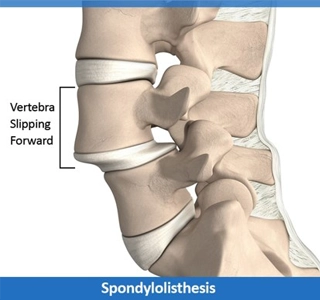
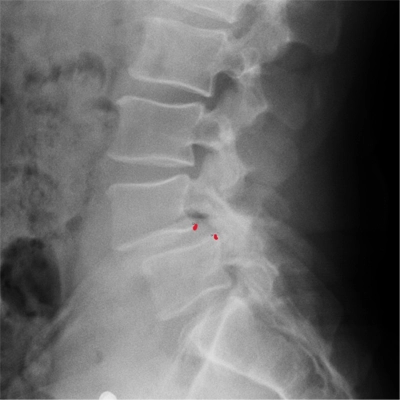
The red markers indicate the location of the spondylolisthesis at the L4-L5 level.
Types of Spondylolisthesis
There are several forms of spondylolisthesis, each developing for different reasons.
Isthmic Spondylolisthesis
This type develops because of a small defect or stress fracture within a portion of the vertebra called the pars interarticularis. It often begins during adolescence and may not become symptomatic until adulthood.
Degenerative Spondylolisthesis
This is the most common form seen in adults over age 50. As the spinal discs and joints naturally wear with age, the vertebrae may gradually become less stable and begin to shift forward.
Congenital Spondylolisthesis
Some individuals are born with slight abnormalities in the spine that increase the likelihood of vertebral slippage later in life.
Traumatic Spondylolisthesis
A significant injury or trauma can damage stabilizing structures within the spine, allowing one vertebra to move out of alignment.
Pathologic Spondylolisthesis
Less commonly, certain diseases affecting bone quality or spinal stability may contribute to vertebral slippage.
Common Symptoms
Symptoms vary considerably depending on the severity of the condition and whether nerves are involved.
Common symptoms include:
- Persistent low back pain
- Pain that increases with standing or walking
- Tight hamstrings
- Muscle spasms
- Hip discomfort
- Pain extending into the buttocks
- Sciatica
- Numbness or tingling in the legs
- Weakness in the lower extremities
- Reduced flexibility
- Difficulty standing upright after prolonged sitting
Some patients notice symptoms only during activity, while others experience discomfort during everyday tasks such as lifting, bending, or getting out of bed.
What Causes Spondylolisthesis?
Several factors may contribute to spinal instability, including:
- Repetitive spinal stress
- Sports involving frequent hyperextension (gymnastics, football, diving, wrestling)
- Natural aging
- Arthritis
- Previous spinal injuries
- Congenital spinal anatomy
- Degenerative disc disease
Many people develop symptoms gradually over months or years before seeking care.
How Is Spondylolisthesis Diagnosed?
A thorough examination is essential before beginning treatment.
At Arc of Life Chiropractic, your evaluation may include:
- Detailed health history
- Orthopedic testing
- Neurological examination
- Range of motion assessment
- Postural evaluation
- Functional movement analysis
- Digital spinal X-rays when clinically appropriate
X-rays allow us to evaluate spinal alignment, determine the degree of vertebral slippage, and identify other conditions that may be contributing to your symptoms.
If additional imaging such as an MRI is indicated, we may recommend obtaining one to evaluate the spinal discs, nerves, and surrounding soft tissues.
Can Chiropractic Care Help?
Many patients with mild to moderate spondylolisthesis benefit from conservative care aimed at improving spinal function and reducing stress on irritated tissues.
Treatment recommendations are always individualized based on your examination findings, imaging, symptoms, and overall health.
Your treatment plan may include:
- Gentle chiropractic adjustments when appropriate
- Flexion-distraction techniques
- Soft tissue therapy
- Therapeutic exercises
- Core stabilization training
- Postural correction
- Activity modification recommendations
- Home stretching programs
- Ergonomic education
Our goal is not to "push the vertebra back into place." Instead, treatment focuses on improving spinal mechanics, reducing inflammation, optimizing movement, and helping support the spine as naturally as possible.
When Chiropractic Adjustments May Not Be Appropriate
Every patient is different.
Certain cases involving significant spinal instability, advanced neurological deficits, fractures, infections, or other serious conditions may require co-management with an orthopedic spine specialist or neurosurgeon.
If chiropractic care is not appropriate, we will discuss the safest recommendations and refer you when necessary.
Why Does Spondylolisthesis Cause Sciatica?
When a vertebra slips forward, nearby spinal nerves may become irritated or compressed.
This irritation can produce symptoms traveling down one or both legs, including:
- Burning pain
- Numbness
- Tingling
- Muscle weakness
- Pain into the calf or foot
Proper diagnosis helps determine whether symptoms originate from spondylolisthesis, a disc injury, spinal stenosis, or another condition.
Can Exercise Help?
Yes—when appropriately prescribed.
Strengthening the muscles that support the spine often plays an important role in conservative treatment.
Many patients benefit from exercises focusing on:
- Core stability
- Hip strength
- Glute activation
- Flexibility
- Balance
- Proper movement mechanics
Certain activities that repeatedly hyperextend the lower back may temporarily worsen symptoms and should be modified during recovery.
When Should You Seek Medical Evaluation?
You should seek prompt medical attention if you experience:
- Loss of bowel or bladder control
- Progressive leg weakness
- Severe numbness
- Significant trauma
- Difficulty walking
- Rapid worsening of symptoms
These symptoms require immediate evaluation.
Frequently Asked Questions
Is surgery always necessary?
No. Many patients improve with conservative care, activity modification, and exercise. Surgery is generally considered only when significant neurological symptoms, severe instability, or persistent pain fail to respond to appropriate treatment.
Can spondylolisthesis heal on its own?
The vertebral slippage itself typically does not reverse. However, many patients experience significant symptom improvement by reducing stress on the spine and improving spinal stability.
Can I still exercise?
In many cases, yes. Remaining active is often beneficial, although certain exercises may need to be temporarily modified.
Is walking good for spondylolisthesis?
Walking is generally well tolerated by many individuals and may help maintain mobility, provided it does not significantly increase symptoms.
Will chiropractic make my spine more unstable?
When a patient is appropriately evaluated and treated using suitable techniques, chiropractic care is intended to improve spinal function—not increase instability. Treatment decisions are based on your individual examination and imaging findings.
Find Out What's Causing Your Back Pain
Every case of low back pain is different. While spondylolisthesis can be a source of discomfort, it is often accompanied by other conditions such as disc degeneration, arthritis, muscle imbalance, or nerve irritation. A comprehensive evaluation helps determine the true source of your symptoms and whether conservative chiropractic care may be appropriate.
At Arc of Life Chiropractic, we take the time to understand your condition, explain your findings, and create a treatment plan tailored to your individual needs. Our goal is to help you reduce pain, improve function, and return to the activities you enjoy with confidence.
If you're experiencing persistent lower back pain, sciatica, numbness, or stiffness, schedule an evaluation with our team to learn whether conservative chiropractic care may be right for you.

Monday
8:00am - 6:15pm
Tuesday
8:00am - 6:15pm
Wednesday
8:00am - 6:15pm
Thursday
8:00am - 6:15pm
Friday
8:00am - 2:00pm
Saturday & Sunday
Closed
Arc of Life Chiropractic
1666 S Pacific Coast Hwy Ste 100
Redondo Beach, CA 90277